
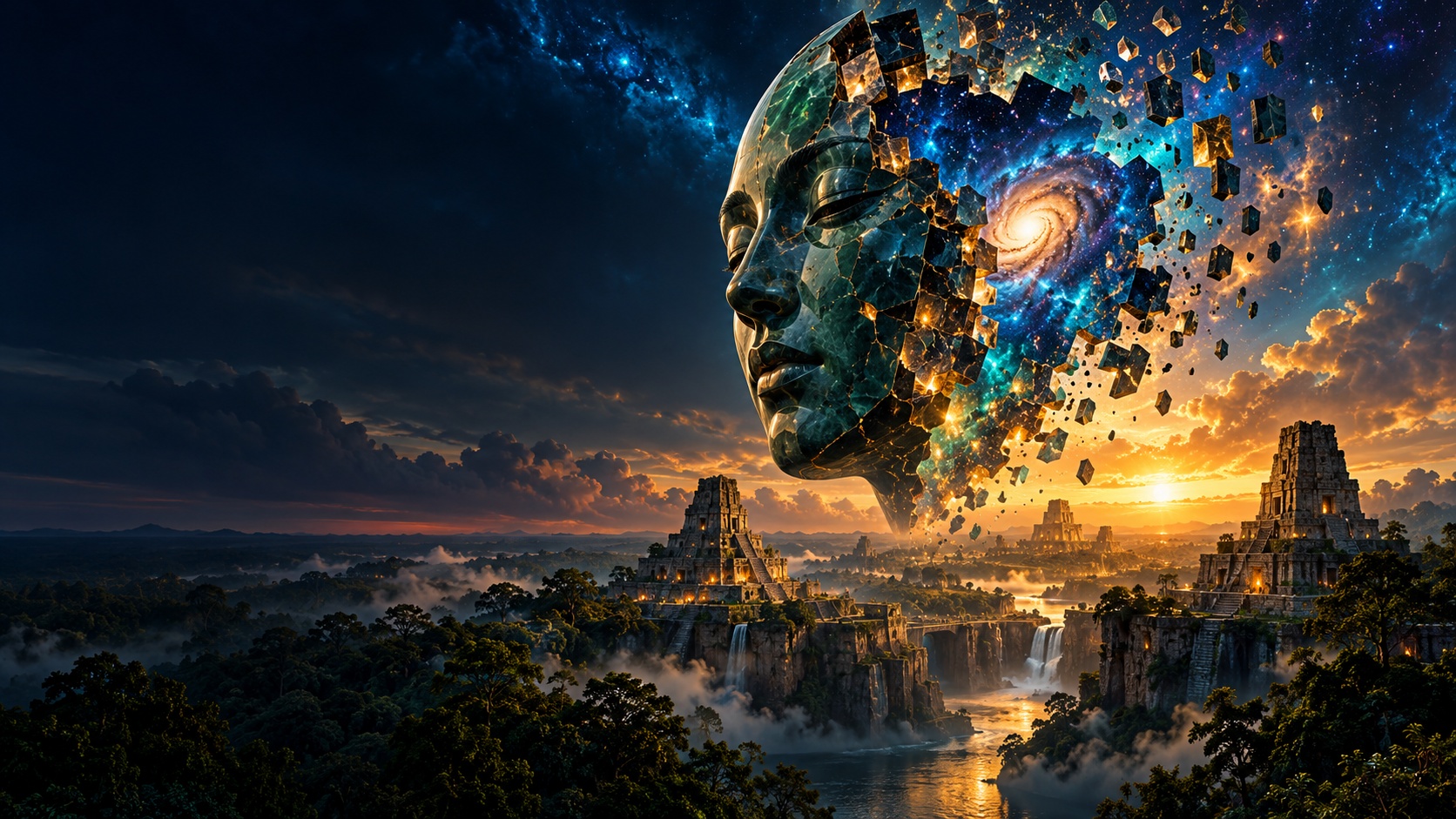
Consciousness & Reality
What If Reality Is Not What We Think It Is?
Exploring consciousness, perception and the possibility of a deeper reality.
We wake each morning into a world that feels solid, predictable and unquestionably real. We see objects, hear sounds, experience emotions and move through something we call time.
But how much do we actually understand about the nature of reality?
And perhaps more importantly, how much of what we experience is a construction of our own consciousness?
The Reality We Experience
Everything we know about the external world reaches us through our senses and is interpreted by the brain.
Colours, sounds, textures and even our perception of time are part of this remarkable process.
What we experience is not necessarily reality in its entirety, but a representation shaped by our biological limitations.
Consider colour. The world does not contain colour in quite the way we experience it. Light has wavelengths, while our visual systems construct the experience of colour.
If something as familiar as colour is partly constructed by perception, what else might we be missing?
The Mystery of Consciousness
Science has made extraordinary progress in understanding the brain, yet one fundamental question remains unresolved:
Why does physical brain activity produce subjective experience?
We can measure electrical signals, observe neural networks and identify brain regions associated with awareness.
But explaining why there is something it feels like to be conscious remains one of philosophy and neuroscience's deepest challenges.
This is commonly called the hard problem of consciousness.
Some researchers consider consciousness an emergent property of complex biological systems. Others explore whether consciousness might be a more fundamental aspect of reality.
Neither perspective has resolved the mystery.
Could Reality Be Information-Based?
Physicist John Archibald Wheeler famously explored the idea of it from bit, suggesting that information may play a foundational role in physical reality.
Consciousness researcher Thomas Campbell takes a different approach through his My Big TOE model, proposing that our physical universe may be understood as a virtual reality within a larger consciousness system.
These are intriguing ideas, but they should not be confused with established scientific conclusions.
Their value lies partly in the questions they encourage us to investigate.
The Observer and Quantum Physics
The famous double-slit experiment demonstrates that quantum systems can produce different observable patterns depending on the experimental arrangement and the availability of which-path information.
It is sometimes claimed that this proves human consciousness creates physical reality.
However, quantum measurement does not necessarily require a conscious observer, and the experiment does not establish that consciousness causes wavefunction collapse.
The genuine scientific mystery is fascinating enough without exaggeration.
Beyond Certainty
Perhaps one of the greatest obstacles to understanding reality is our attachment to certainty.
We inherit beliefs, construct identities and gradually become comfortable with explanations that make the world seem predictable.
But genuine exploration requires something different.
It requires curiosity, humility and the willingness to question even our most cherished assumptions.
We may never possess a complete explanation of existence.
Yet the search itself can transform how we understand ourselves, others and the world we share.
A final thought
Perhaps the greatest illusion is not the reality we perceive, but our certainty that we understand it.
White World Bridger
Exploring consciousness, questioning reality and seeking truth beyond the familiar.
A project by Cimi
A Rabbit Hole Worth Falling Into